 صحافة بلادي صحيفة إلكترونية مغاربية متجددة على مدار الساعة تعنى بشؤون المغرب الجزائر ليبيا موريتانيا تونس

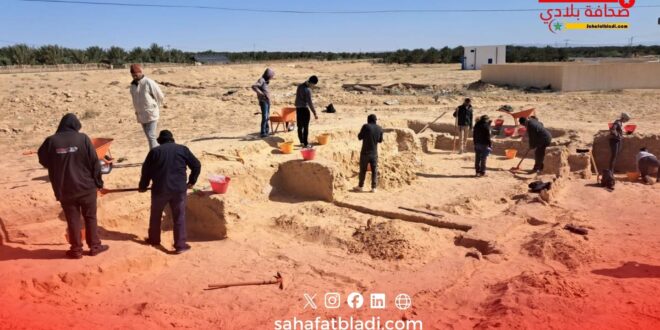
Tozeur –Continue southWestern TunisiaArchaeological excavations lead to the gradual uncovering of landmarks of a Roman city that had been buried under the sand for centuries, at the “Castelia” site, as part of a joint scientific project between Tunisian and Italian researchers.
The National Institute of Heritage reported that new field data indicate the presence of an integrated urban structure, and not just isolated structures, as interlocking walls and adjacent buildings were observed linked to a large architectural space located adjacent to a previously discovered Roman church.
In the details of the discoveries, recent excavations focused on a space with a courtyard in the middle surrounded by a group of rooms, numbering eight units, inside which traces of burning and the remains of building materials were found, which reinforces the hypothesis of the existence of ancient craft activity, likely related to the gypsum industry.
Preliminary studies also revealed a succession of multiple urban stages at the site, extending in time from the fifth to the seventh century AD, which reflects the continuity of human settlement during the period of late antiquity.
This project comes within the framework of a research program extending between 2026 and 2028, in partnership between the National Institute of Heritage and the University of Rome “Tor Fregate”, with the aim of deepening the archaeological studies that began in 2017, when the first Roman church was discovered on the site.
Research is not limited to excavations only, as a multidisciplinary team is working on analyzing the building materials used, studying archaeological finds, especially ceramics, in addition to examining plant remains, with the aim of reconstructing the features of the daily life and natural environment of the inhabitants of the region in that era.
In parallel, the discovered monuments are being documented using modern technologies, including 3D scanning, in a step aimed at preserving the site and promoting its integration into the tourist and cultural itineraries in southern Tunisia.
Those in charge of the project hope that this discovery will contribute to valuing local heritage, by involving regional actors and civil society in a common vision linkingScientific researchCultural and tourism development.
Source:“My press”